One of the most important figures in modern learning theory is B.F. Skinner, a psychologist who helped us understand how animals (and humans!) learn best. His research showed that behaviours that are rewarded are more likely to be repeated, while behaviours that are punished may stop temporarily — but often come back or cause other problems.
This is what’s known as operant conditioning. Basically, what follows a behaviour affects whether or not the animal wants to do it again.
Why we use reinforcement
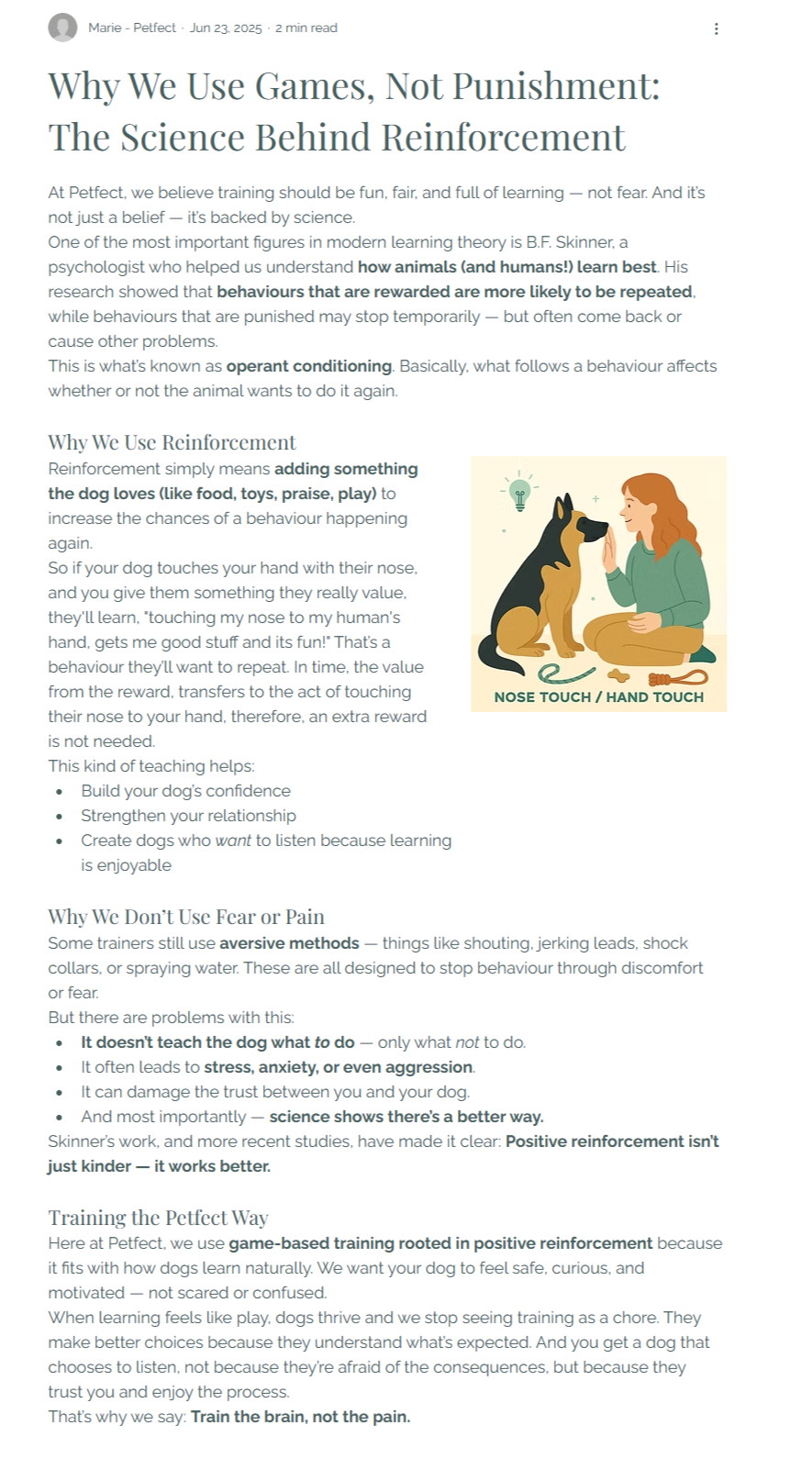
Reinforcement simply means adding something the dog loves (like food, toys, praise, or play) to increase the chances of a behaviour happening again.
So if your dog touches your hand with their nose, and you give them something they really value, they learn: “touching my nose to my human’s hand gets me good stuff and it’s fun.” That’s a behaviour they’ll want to repeat. In time, the value from the reward transfers to the act of touching their nose to your hand, therefore an extra reward is not needed.
This kind of teaching helps:
- Build your dog’s confidence
- Strengthen your relationship
- Create dogs who want to listen because learning is enjoyable
Why we don’t use fear or pain
Some trainers still use aversive methods — things like shouting, jerking leads, shock collars, or spraying water. These are all designed to stop behaviour through discomfort or fear.
But there are problems with this:
- It doesn’t teach the dog what to do — only what not to do.
- It often leads to stress, anxiety, or even aggression.
- It can damage the trust between you and your dog.
- And most importantly — science shows there’s a better way.
Skinner’s work, and more recent studies, have made it clear: positive reinforcement isn’t just kinder — it works better.
Training the Petfect way
Here at Petfect, we use game-based training rooted in positive reinforcement because it fits with how dogs learn naturally. We want your dog to feel safe, curious, and motivated — not scared or confused.
When learning feels like play, dogs thrive and we stop seeing training as a chore. They make better choices because they understand what’s expected. And you get a dog that chooses to listen, not because they’re afraid of the consequences, but because they trust you and enjoy the process.
That’s why we say: Train the brain, not the pain.
Train with Marie